
Last week, I wrote about the marketing/BD tension many firms are feeling right now.
Inbound isn’t what it used to be. The pipeline feels thinner. And in response, firms are leaning harder into business development to compensate.
That’s a rational move. Business development drives today’s revenue, and when marketing underperforms, you have to make up the difference somewhere.
But there’s a risk in how firms are interpreting what’s happening. Many are starting to question whether marketing still works at all.
It does. Flywheels still work. The problem is that most firms are still running a flywheel that was built for a different era.
The Flywheel You Built
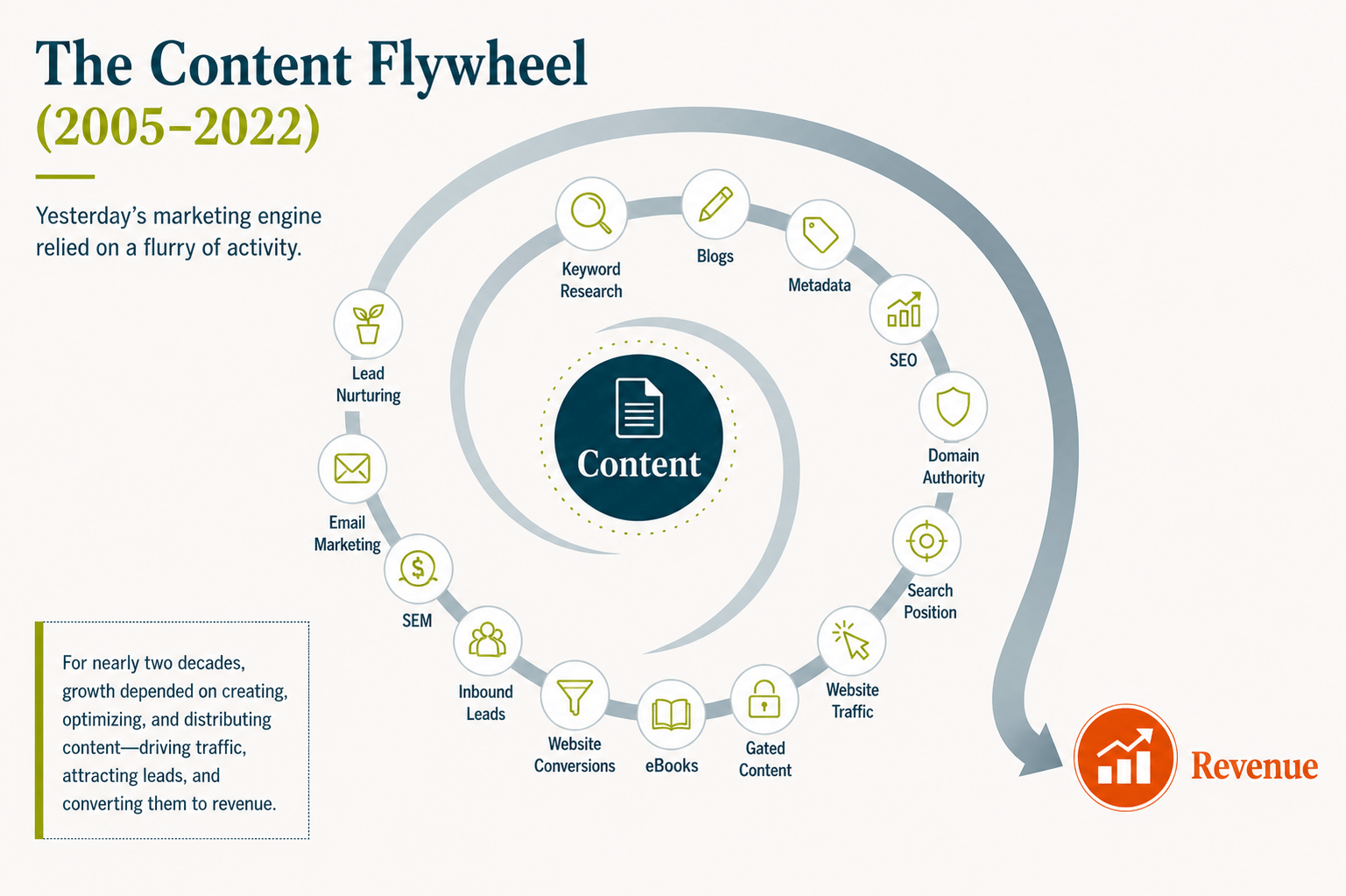
For nearly two decades, growth in professional services was powered by a content flywheel.
The model was straightforward. You identified what your audience was searching for, created content to match that demand, and used distribution channels (primarily search and email) to attract, convert, and nurture prospects over time. It was an elegant system. It created visibility, generated leads, and, when executed well, produced real, measurable growth.
What That Model Taught Us
The content flywheel didn’t just create growth. It shaped how firms think about marketing. Strategy became synonymous with identifying topics. Execution became a matter of producing and optimizing content. And success was largely a function of consistency and volume. For a long time, that was enough.
In that world, you didn’t need a strong point of view to succeed. You needed to be helpful, relevant, and pervasive. Over time, marketing became a collection of discrete activities: blogs, webinars, eBooks, campaigns.
Each activity could stand on its own and generate results independently. A prospect could enter the system from almost anywhere. A single article could bring someone into your world, regardless of what came before or after it. That model was efficient. It was scalable. And for a long time, it worked.
But it also had a hidden cost. SEO trained many of us to think small. Small topics. Small increments of value. Small, incremental improvements designed to capture existing demand rather than create new demand. Heck, a lot of firms stopped spending any money at all on what we’d consider traditional marketing (think ad dollars).
What’s Replacing It
The underlying mechanics that powered the content flywheel are changing.
Search is no longer the same gateway to business it once was. AI is reshaping how clients discover and evaluate firms. And the volume of content being produced (most of it indistinguishable) has reached a point where more activity no longer translates into more attention.
You can still publish. You can still optimize. You can still distribute. But those actions don’t offer the same value they used to. The old flywheel relied on distribution mechanics to generate momentum. Content led to search engine visibility. Visibility led to traffic. Traffic led to leads. Leads led to revenue.
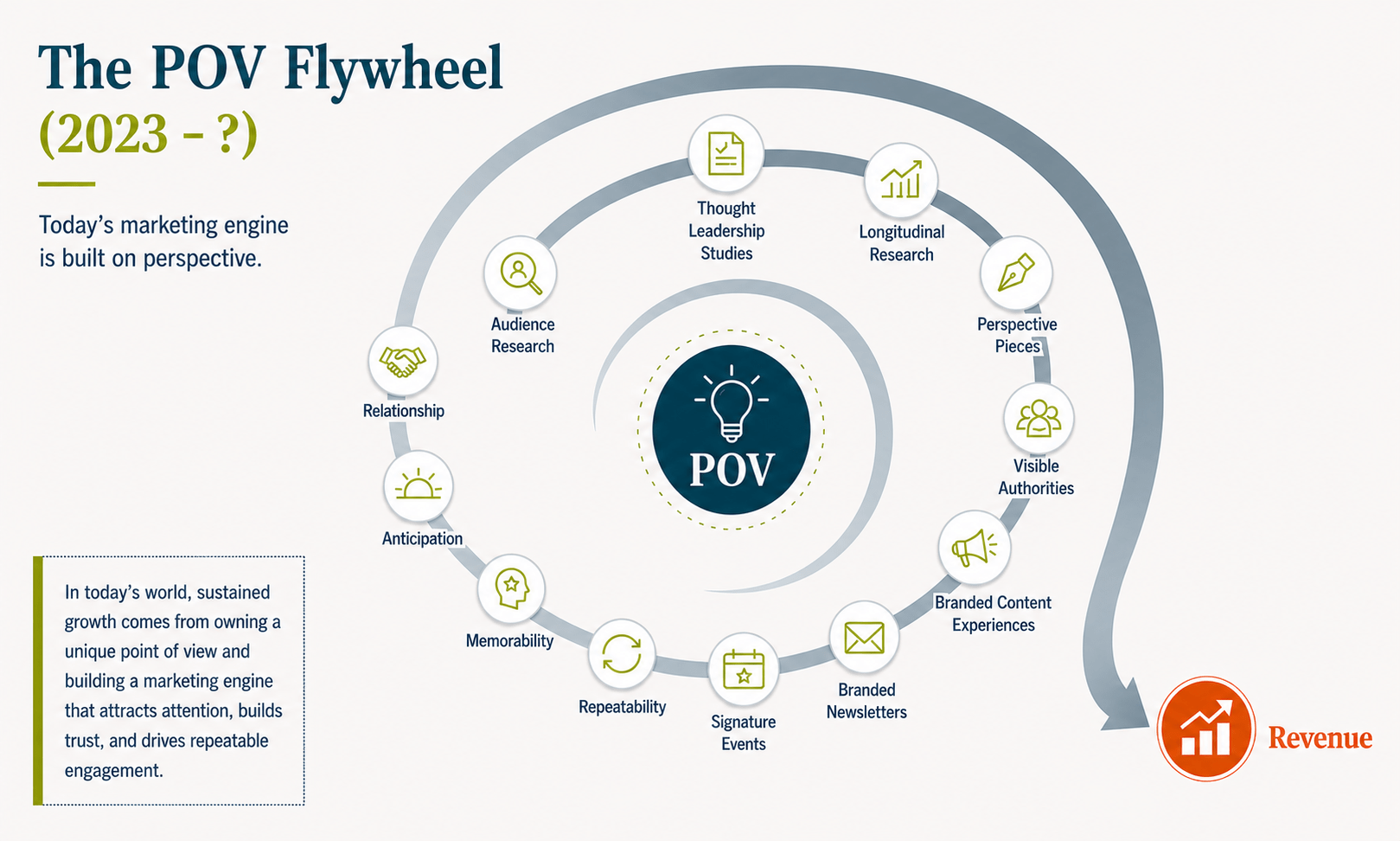
A different model is emerging in the AI era. One that doesn’t begin with content, but with perspective. It’s no longer just about what you publish, but what you believe. It’s not just about how you answer your clients’ questions, but how you help them see their problems differently.
I like to call this POV-led growth.
From Discrete Activities to Connected Thinking
In the old model, each piece of marketing could stand on its own. A blog post, a webinar, or a guide could generate value independently, without needing to connect to a broader narrative. It was sort of like a 1980’s sitcom. Each episode stood alone. Anyone could jump into a show at any time and figure out what was going on because you didn’t need to know what happened before.
In the new model, those same activities still exist, but they’re no longer independent. Research informs perspective. Perspective shapes what you write, when, and how. And that perspective becomes the backbone of unique branded assets (digital experiences, newsletters, and signature events).
These assets are purposely called assets because they’re built to be repeatable, to create anticipation for their release, and to build a true marketing relationship between a firm and its clients and prospects. Revenue follows from there.
This new flywheel operates more like a modern streaming series. It requires a story arc that develops over time. When someone new shows up, they’re curious to go back in time to “get caught up” and understand the context of where the story has been and where it’s heading.
The goal is no longer just to be found. It’s to be understood, remembered, and preferred for something specific.
A New Source of Momentum
This shift changes where momentum comes from. The content flywheel was powered by activity and optimization. The more effectively you could produce and distribute content, the more momentum you could generate.
The POV flywheel is powered by something different: intellectual gravity. A firm with a clear, distinct point of view attracts attention in a different way. Clients begin to associate it with its perspective. Ideas travel beyond individual pieces of content. Conversations start before your business development team gets involved.
That’s what creates anticipation. That’s what builds memorability. And that’s what turns marketing back into a compounding asset.
The Conversation to Start Now
Right now, many firms recognize that something has changed, but they haven’t fully adapted their approach. Some are trying to push the old flywheel harder, faster, or cheaper. They’re producing more content, accelerating production, and expanding into more channels. Others are pulling back on marketing altogether and relying more heavily on business development.
Neither approach addresses the underlying issue. The problem isn’t a lack of effort. It’s a misalignment between how the firm is marketing and how clients are making decisions.
If marketing is going to function as a growth engine in the next decade, it won’t be because firms produce more content than their competitors. It will be because they develop a more distinct point of view, and do a better job of building a system around it.
So the question isn’t: “How do we generate more leads?” It’s “What do we believe that’s worth organizing our marketing around?”
For many firms, that conversation hasn’t happened yet. It’s time it does.
